
While the global market is still discussing competition in GPUs, ASICs, data centers, AI agents, and large-scale models, a more fundamental question is emerging: Who will build these industries, who will drive the real-world application of these technologies, and who can continuously provide a high-quality talent supply for the industrial chain over the next decade?
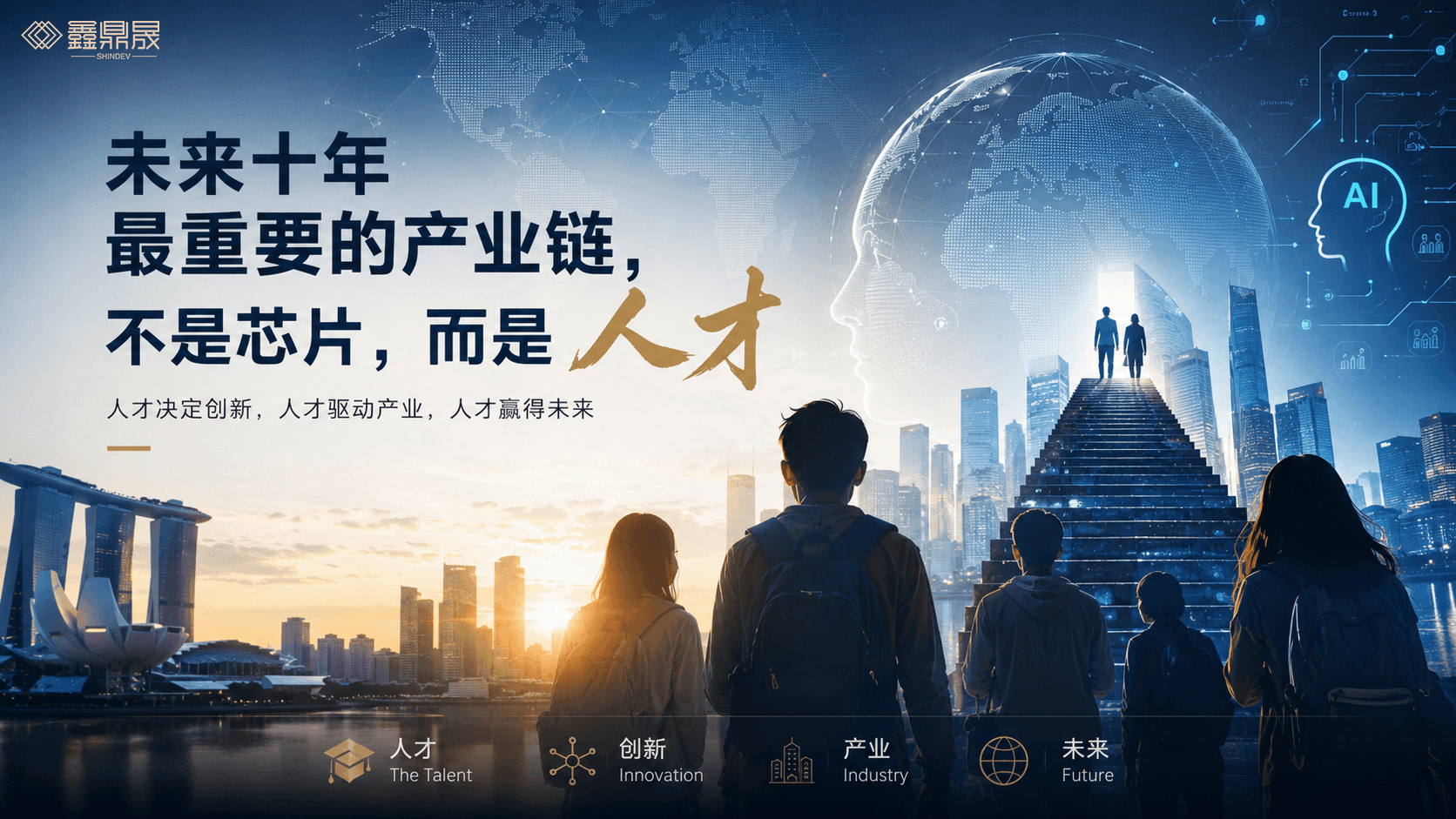
SHINDEV believes that the most important industrial chain in the next decade may not be the chip industry chain, the computing power industry chain, or the model industry chain, but rather the talent industry chain that supports the continuous evolution of these industries.
Recently, China's college entrance examination (Gaokao) has once again become a focus of social attention. On the surface, the Gaokao is an educational selection process; at a deeper level, it is also an important window into observing a country's talent structure, academic orientation, industrial expectations, and future competitiveness. Especially today, with artificial intelligence accelerating the reshaping of industrial structures, how the education system responds to the technological revolution and how young talent enters emerging industries are no longer just educational issues, but core issues in the restructuring of the industrial chain.
For an investment research institution that has long focused on global capital flows, technological innovation, and industrial chain upgrading, the Gaokao is not an isolated social hotspot, but an entry point for observing future industrial competition.
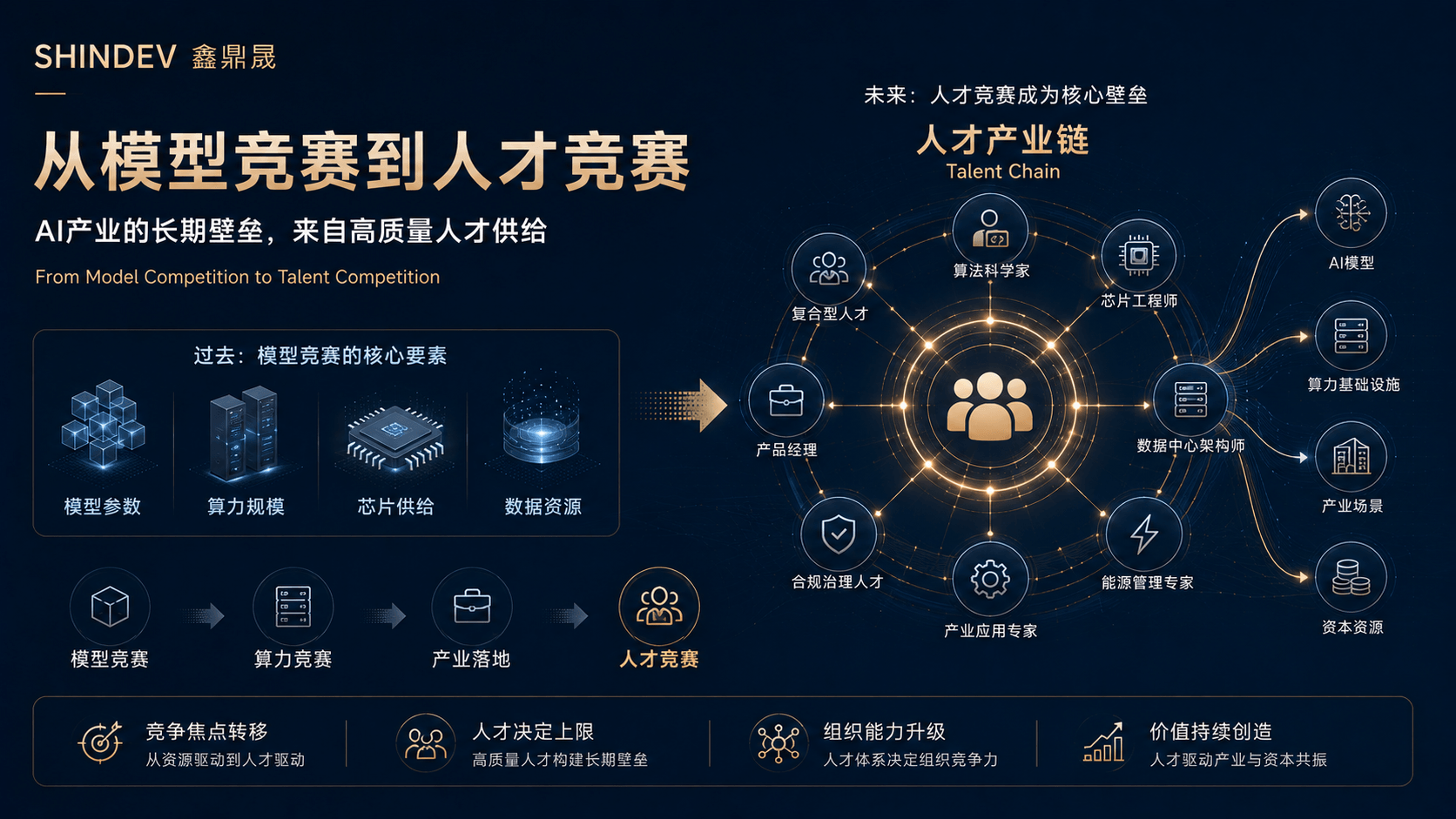
In recent years, the focus of global AI competition has primarily been on model parameters, computing power scale, chip supply, and data resources. Countries, companies, and capital markets have continuously vied for dominance in large-scale model capabilities, computing infrastructure, and application ecosystems.
However, as AI enters deeper waters, the focus of competition is shifting.
Models can be iterated, computing power can be built, capital can be invested, and data can be accumulated. But what truly determines whether technology can achieve sustained breakthroughs, whether the industry can scale up, and whether companies can build long-term barriers to entry is talent.
The AI industry is not a single technological track, but a highly complex industrial system. It requires not only algorithm scientists, but also chip engineers, data center architects, energy management experts, industry application experts, compliance and governance talent, product managers, enterprise service teams, and multi-skilled talent who understand business scenarios.
This means that competition in the AI-era industry chain has essentially extended from "who has more computing power" to "who can continuously organize, cultivate, attract, and utilize high-quality talent."
For the future industry chain, talent is no longer just a supporting condition for enterprise development, but one of the most important production factors within the industry chain itself.
The Gaokao in China is noteworthy not only because it carries individual destinies and societal sentiments, but also because it reflects, to some extent, future talent flows and changes in industrial structure.
As fields such as artificial intelligence, integrated circuits, new energy, new materials, biotechnology, and high-end manufacturing continue to gain momentum, the importance of basic disciplines, engineering capabilities, digital literacy, and interdisciplinary collaboration is being re-evaluated. Future industrial competition will not belong solely to individuals with single specialties, but to those who can build connections between technology, industry, and business.
This also explains why major global economies are continuously promoting AI education, skills training, STEM system upgrades, and the introduction of scientific and technological talent. Because artificial intelligence will not simply replace everyone, but will reshape the talent structure, making those with technological understanding, industrial judgment, and innovative practical abilities even scarcer.
From this perspective, the Gaokao is merely a window. It forces us to rethink: What kind of people do future industries need? How should the education system respond to industrial changes? And how can enterprises and capital participate in the long-term development of talent and the industrial chain?
SHINDEV believes that truly visionary institutions should not focus solely on short-term trends, but rather on the long-term structures behind them. The National College Entrance Examination (Gaokao) reflects not only educational issues, but also the profound relationship between national competition, industrial upgrading, and talent supply.
Globally, talent competition in the AI era has become a crucial component of national strategies, capital allocation, and industrial layout.
The US continues to strengthen its AI investment and technological innovation ecosystem, leveraging universities, tech giants, venture capital, and the influx of global talent to form a powerful cycle from basic research to commercial applications. Its advantage lies not only in ample capital and technological leadership, but also in its ability to rapidly organize talent, funding, application scenarios, and entrepreneurial spirit.
Europe, on the other hand, places greater emphasis on the synergy of economic structural reforms, security governance, and technological regulatory systems. Faced with the changes in production methods, industrial security issues, and social governance challenges brought about by AI, Europe is attempting to promote technological innovation and institutional development in a more robust manner. While these paths differ in pace, they both point to a core issue: future competition will not only be a competition of technological capabilities, but also a competition of talent, regulations, and industrial resilience.
Singapore's strategic significance lies in its emerging role as a crucial innovation hub connecting capital, technology, talent, and industrial resources in the Asia-Pacific region. As an international financial center, a regional technology node, and a vital platform for global companies entering the Asia-Pacific market, Singapore boasts a highly open institutional environment, an international talent structure, stable business rules, and policy sensitivity geared towards future industries.
This is also one of the key reasons why SHINDEV has chosen Singapore as the location for its global strategic operations headquarters.
In the context of global industrial chain restructuring, Singapore is not merely a geographical choice, but a strategic one. It represents a more open international perspective, more efficient resource connectivity, and organizational upgrades geared towards the global technology industry and capital markets.
From Hong Kong to Singapore, SHINDEV is not simply relocating regionally, but proactively entering a higher-dimensional strategic position in an era of global industrial, capital, and talent chain restructuring.
Computing power is becoming the new infrastructure of the AI era, but computing power itself does not automatically generate value.
Data centers require planning, chips require design, models require training, applications require implementation, industry scenarios require understanding, business models require validation, and risks and compliance require management. Ultimately, every link in the chain relies on people.
Without a sufficient number of high-quality talents, computing power becomes a cost; without industry understanding, models remain mere technical demonstrations; without organizational capabilities and capital efficiency, innovation struggles to weather economic cycles.
Therefore, SHINDEV believes that the core of future supply chain competition lies not just in resource possession, but in the ability to organize those resources. Talent is the key variable connecting capital, technology, industry, and the market.
Capital can determine where resources go, technology can improve efficiency, but talent determines whether resources can be truly activated, whether technology can be truly transformed, and whether the supply chain can achieve sustainable growth.
This is why the supply chain narrative for the next decade cannot be limited to chips, computing power, and models. What truly deserves attention is: which regions can continuously attract talent, which companies can continuously cultivate talent, and which industrial ecosystems can maximize the value of talent.
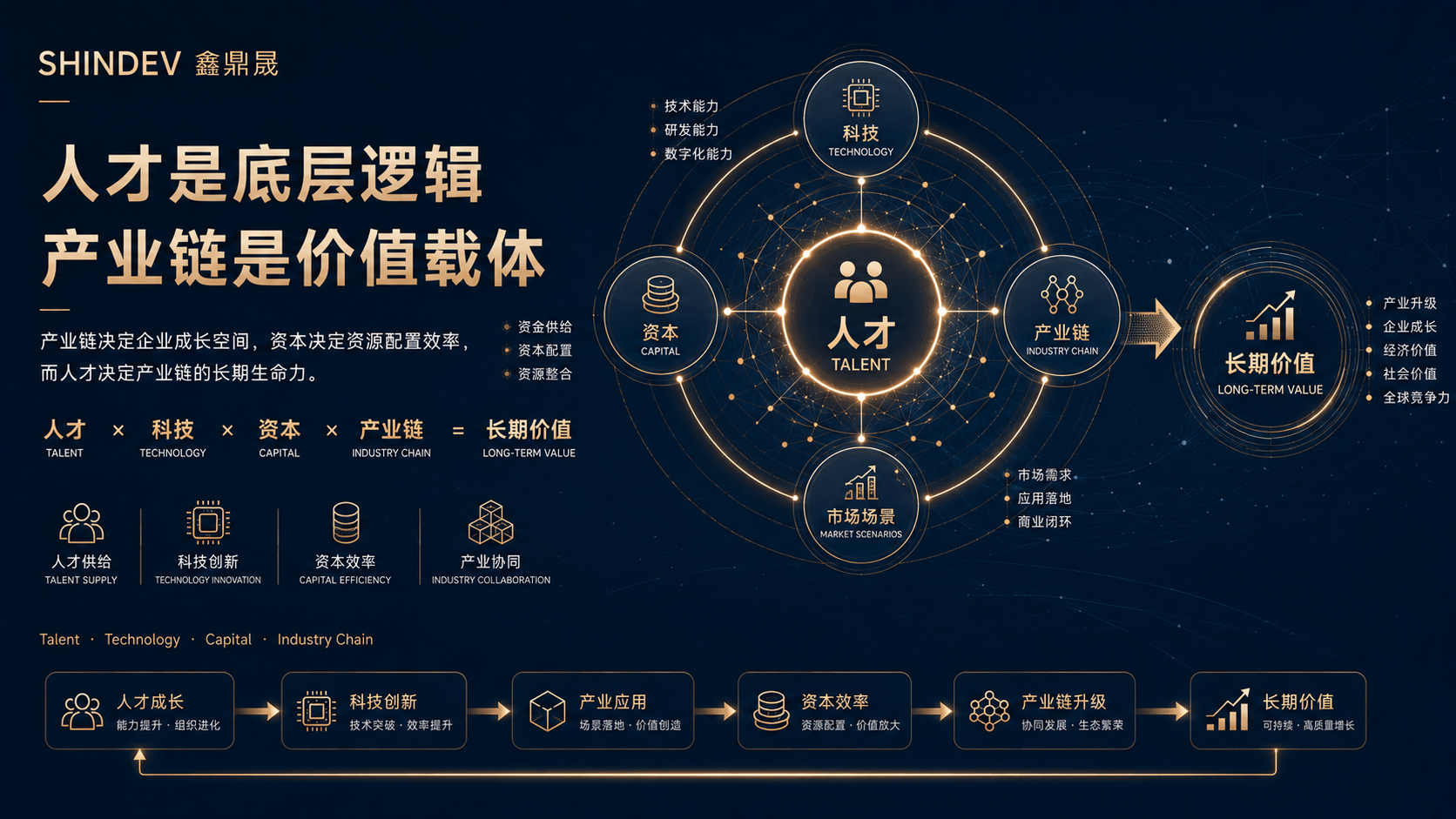
As an institution focusing on global capital, technological innovation, and industrial chain upgrading, SHINDEV believes that the industrial chain determines a company's growth potential, capital determines resource allocation efficiency, and talent determines the long-term vitality of the industrial chain.
The future industrial chain will not be merely a linear combination of manufacturing, supply, R&D, and sales, but will become a value system jointly constituted by capital, technology, talent, scenarios, and ecosystems.
In this system, talent is the starting point, technology is the tool, capital is the link, the industrial chain is the carrier, and long-term value is the ultimate result.
Therefore, SHINDEV's judgment on the future industrial chain is very clear: industries with true long-term potential must not only have market space and technological trends, but also a continuous supply of talent, complete industrial synergy capabilities, and global resource organization capabilities.
In the next decade, those who understand the relationship between talent and the industrial chain will be able to see the direction of industrial value earlier; those who can place capital, technology, and talent within the same strategic framework are more likely to take the initiative in the new round of global industrial competition.
The college entrance examination is merely an observation window. This reminds us that the future of any industry ultimately boils down to human growth, human creativity, and human organizational capabilities.
For SHINDEV, this is precisely the core meaning of its global strategic upgrade: using Singapore as a strategic fulcrum, and with a global perspective, linking capital, technology, markets, and talent resources to find truly long-term value-driven growth directions within the major cycle of industrial chain restructuring.
The most important industrial chain of the future may not be a single sector, but rather a talent industrial chain capable of continuously fostering innovation, supporting technology, amplifying capital efficiency, and driving industrial upgrading.
This will be the deepest competition in the AI era, and a long-term issue that SHINDEV continues to focus on.